
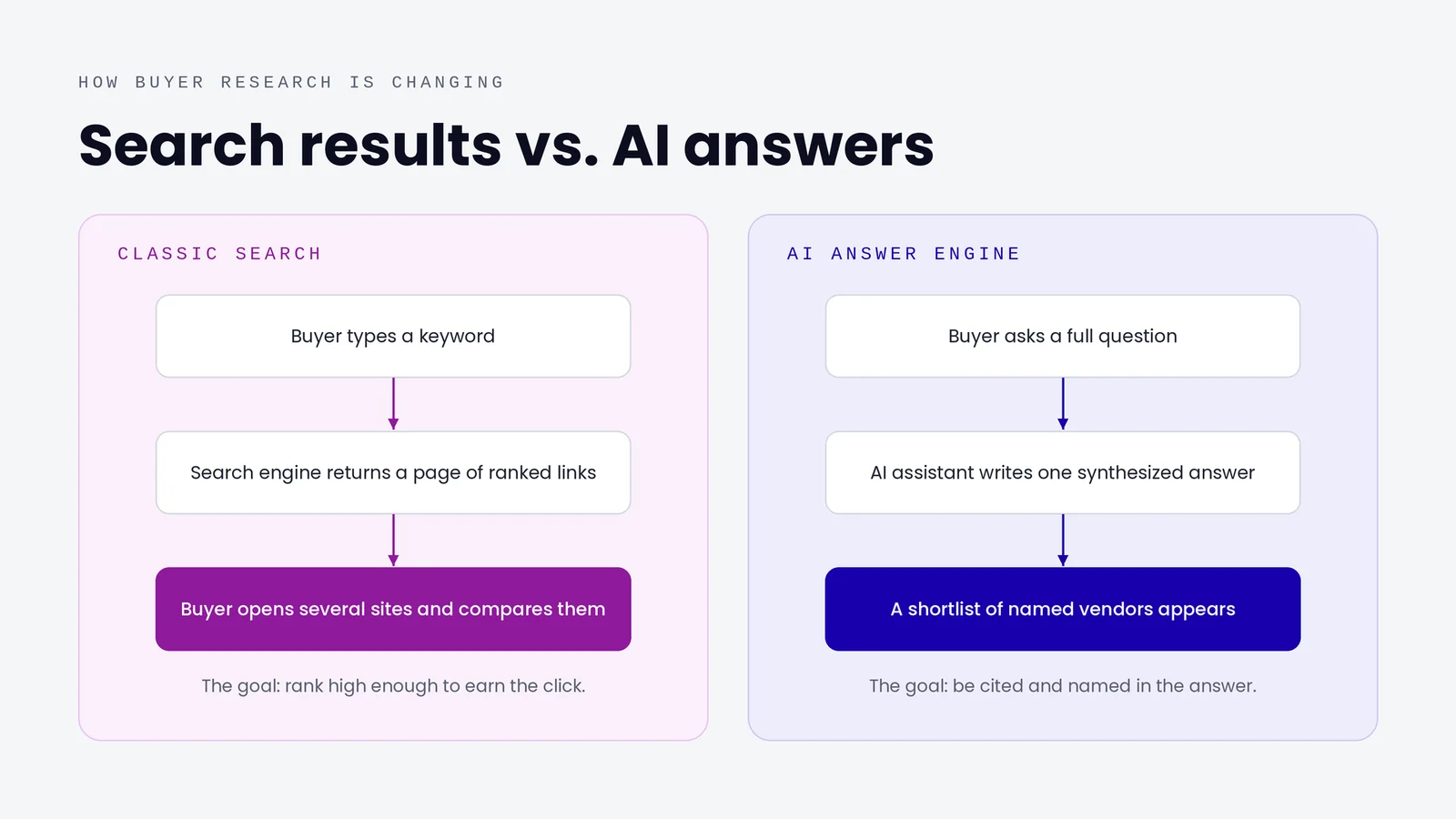
A buyer who once typed “managed IT services Toronto” into Google now asks a full question instead: which Canadian partners can help us roll out Microsoft Copilot safely? An AI assistant answers in a paragraph and names a few companies. If yours is not one of them, that buyer may never visit your website.
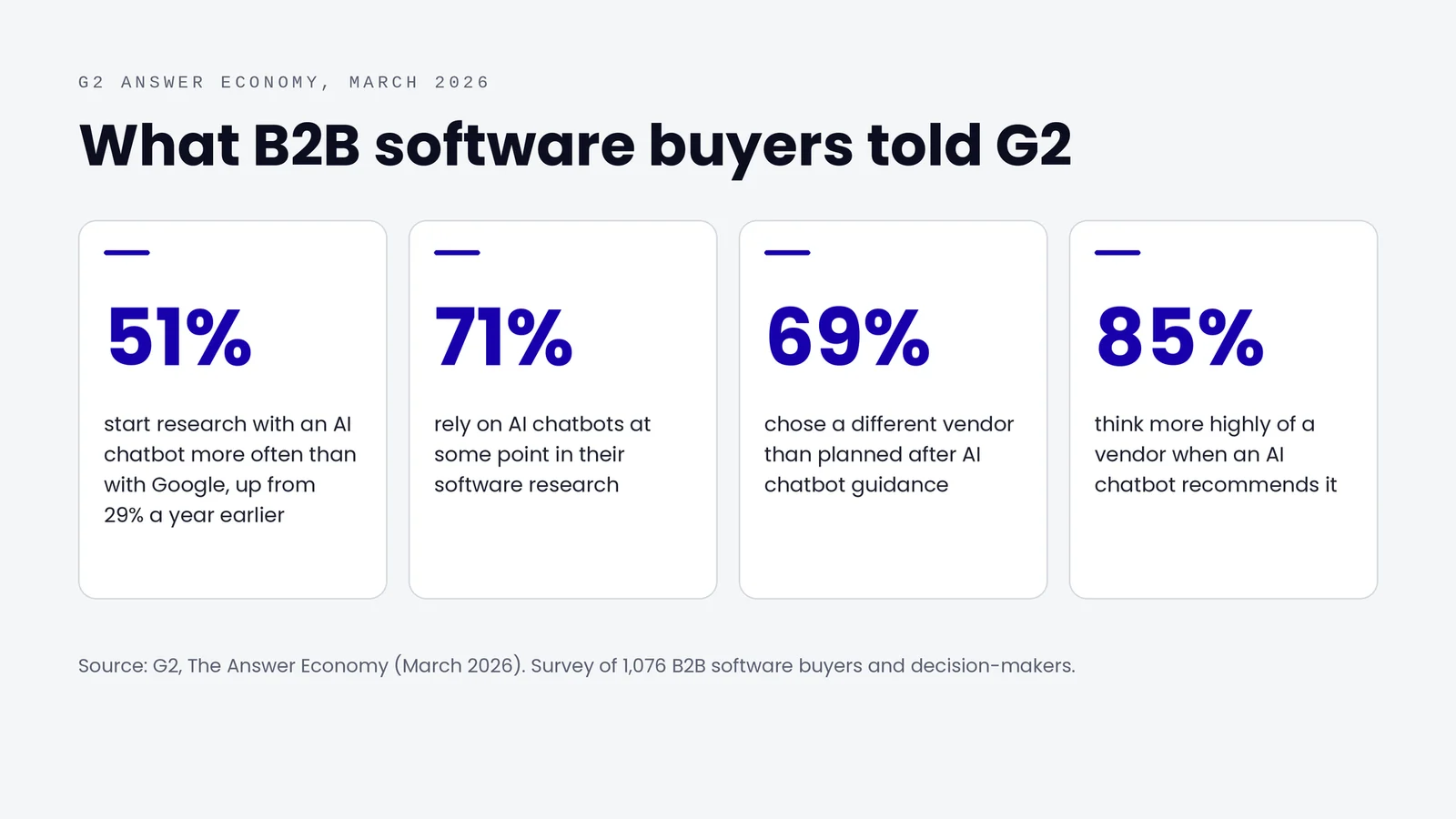
That shift has a name, answer engine optimization (AEO), and the data behind it is hard to ignore. G2’s March 2026 survey of 1,076 B2B software buyers found that 51% now start their research with an AI chatbot more often than with Google, up from 29% a year earlier. Here is what AEO is, why it matters to B2B marketers, and the five steps that give your content its best chance of becoming the answer.
What Is Answer Engine Optimization?
Answer engine optimization is the practice of structuring your content so that AI assistants such as Microsoft Copilot, ChatGPT and Perplexity can find it, understand it and present it accurately. Microsoft Advertising’s January 2026 guide draws a useful line. AEO is about clarity, so assistants read your facts correctly. Generative engine optimization (GEO) is about credibility, so they trust and recommend you. Many practitioners use the two terms interchangeably.
AEO does not replace search engine optimization. Microsoft’s own guide says SEO still matters but is no longer the whole game. What changes is the goal. SEO aims to rank a page. AEO aims to have your answer, and your company name, appear inside the response.
Why AEO Matters for B2B Marketing Now
G2’s research puts numbers on the change. Beyond the 51% who start with a chatbot, 71% rely on one at some point in their software research, and 69% said a chatbot led them to choose a different vendor than they had planned. One in three bought from a vendor they had never heard of. Being named carries weight too: 85% of buyers think more highly of a vendor when a chatbot includes it in a recommendation.
Two cautions apply. G2 surveyed software buyers, so the figures describe that audience rather than every B2B purchase. Teams selling IT services should check in their own sales conversations whether buyers describe the same pattern. Second, clicks are shrinking even where search still dominates. Pew Research Center analyzed the browsing of 900 U.S. adults in March 2025 and found that people clicked a traditional result in 8% of visits when Google showed an AI summary, against 15% when it did not. Visibility inside the answer now matters as much as position on the page.
Five Steps to Become the Answer
None of these steps needs a new platform. They need discipline and a named owner.
1. Write for the questions buyers actually ask
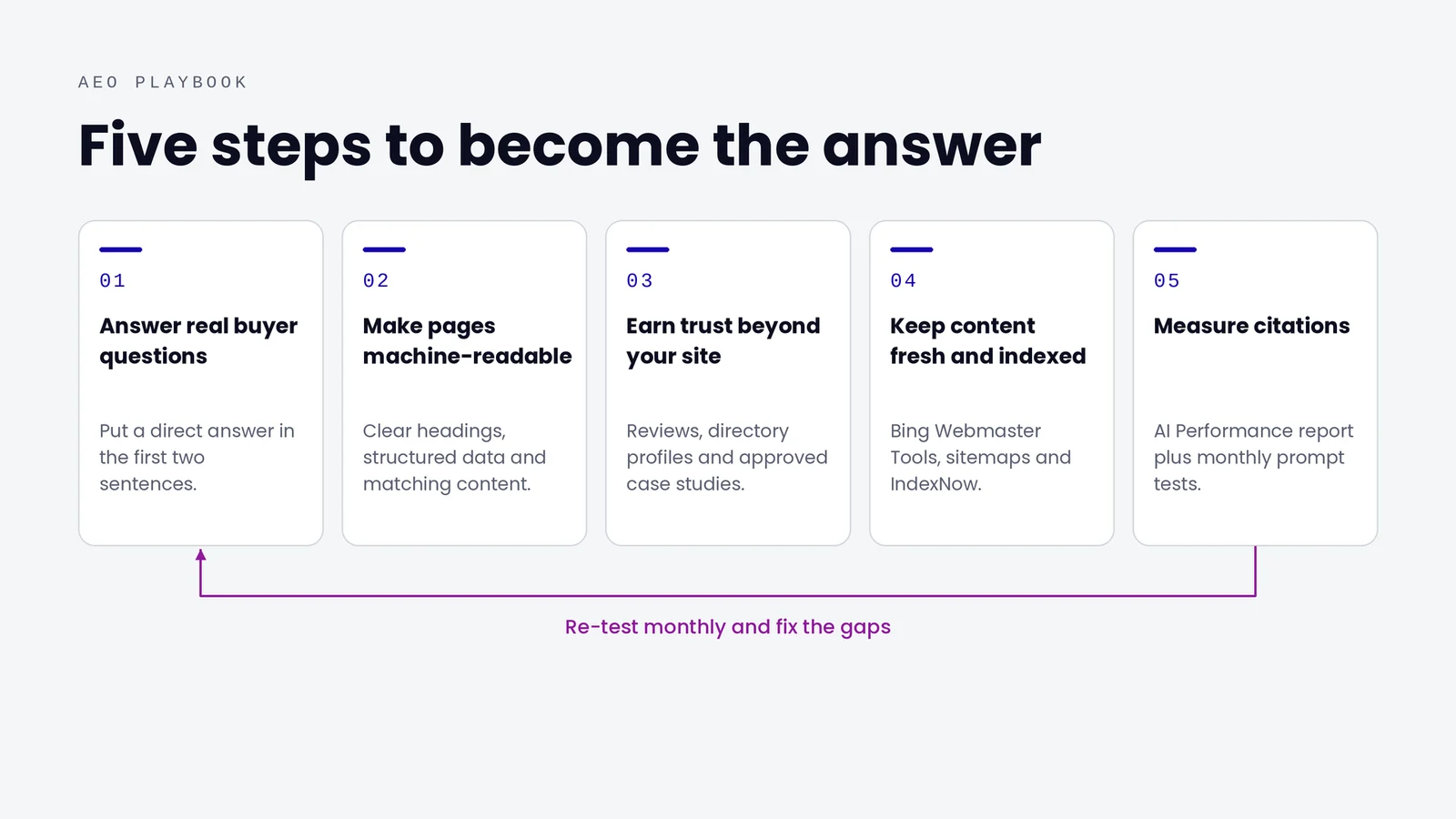
AI assistants respond to full questions, so build pages around them: “How long does a Microsoft 365 migration take?” or “What does a managed IT service include?” Put a direct answer in the first two sentences, then add detail. G2 advises identifying the prompts your buyers use and writing content that answers them directly. Discovery calls and support tickets are the best source of those questions. A short comparison table or checklist also gives an assistant clean material to quote.
2. Make your pages machine-readable
Use clear headings, short paragraphs and structured data (Schema.org markup) for your organization, services, articles and FAQs. Microsoft’s guide recommends structured data and warns against showing bots different content from what visitors see. Some independent SEO analysts point out that public evidence on how language models use schema is thin, so treat it as good hygiene rather than a guaranteed lever.
3. Earn trust signals beyond your own site
Assistants weigh what others say about you. In G2’s survey, citations from software review sites were the top factor in buyers’ confidence in a chatbot’s answer. For a services firm, that points to current client reviews, a complete partner directory profile, published case studies with client approval, and company facts that match everywhere you appear.
4. Keep content fresh and indexed
Assistants can only cite what they can find. Verify your site in Bing Webmaster Tools, submit a sitemap, and use IndexNow to notify participating search engines when pages change. Review key pages on a schedule and show the date of the last review. Consolidate overlapping articles so that each question has one authoritative answer on your site.
5. Measure citations, not only clicks
Microsoft released AI Performance in Bing Webmaster Tools as a public preview on February 10, 2026. It shows how often your pages are cited in Copilot, AI-generated summaries in Bing and select partner integrations, which pages are cited, and the grounding queries behind those citations. It does not report clicks. Pair it with a monthly manual check: ask the ten questions your buyers ask in Copilot, ChatGPT and Perplexity, and record whether your company appears and whether the answer is accurate. Treat a missing citation as a signal to improve that page, not as a verdict on your brand.
AEO Is a Data Problem as Much as a Content Problem
Assistants answer from facts, so the facts have to agree. If your website describes a service one way, your partner listing another and a two-year-old press release a third, an AI summary can pick any of them. Fixing that is information governance: one approved description of each service, one owner, and a process for updating every place it appears.
That is work AIM’s AI and Data practice does with clients, and as a Microsoft Solutions Partner AIM also helps organizations adopt Microsoft 365 and Copilot. The same discipline pays off inside your own walls, because Copilot answers employees’ questions from your documents and data. Accurate, well-governed content improves those answers too.
Frequently Asked Questions
What is the difference between AEO and SEO?
SEO aims to rank pages in search results. AEO aims to have your content cited and your brand named in AI-generated answers. They share the same foundations: crawlable, accurate, well-structured content.
Can I track whether Copilot cites my website?
Partly. The AI Performance report in Bing Webmaster Tools shows citation counts and cited pages across Microsoft’s AI experiences and select partner integrations. It does not report clicks and does not cover every assistant, so manual prompt testing is still needed.
How long does AEO take to show results?
Published timelines vary widely and none is authoritative. Set a baseline today by recording which of your target questions already name your company, then re-test monthly.
Start With a 30-Day Audit
Pick ten questions a prospect would ask when shortlisting an IT partner. Run each in Copilot, ChatGPT and Perplexity, and record who is named, what is said about your company and which sources are cited. Fix the gaps in order: inaccurate facts first, missing answer pages second, trust signals third. Assign one person to own the results, and share them with your sales team, who hear the same questions from buyers every week. Repeat monthly and watch the citation trend in Bing Webmaster Tools. To talk through what an audit would look like for your organization, contact the AIM team.