
AI is changing how we build software, and it is happening at a breakneck pace. Today, we are seeing the rise of “agentic development,” an approach where autonomous AI agents plan, design, and write code, and generate tests for us in seconds. It feels almost magical, but there is a major catch that many teams learn the hard way: AI agents make mistakes, hallucinate details, and take lazy shortcuts if they are not guided properly. To build reliable, production-ready software with AI agents, developers need to follow one simple, non-negotiable rule: write your test cases before any code gets generated.
When you let an AI agent write code first and then ask it to write test cases afterward, you fall directly into a trap called confirmation bias. AI agents are remarkably good at reading existing code and generating tests that pass against that specific implementation. If the AI wrote buggy or logically flawed code in the first step, its post-development tests will simply double down on those exact same mistakes. Instead of checking whether the software meets actual user needs, the tests merely confirm that the code does what it currently does. In practice, you end up approving bugs as intentional features. Consider a discount calculator that rounds the wrong way. A test written after the fact will assert the wrong total, pass, and hand the team a green dashboard and a false sense of safety.
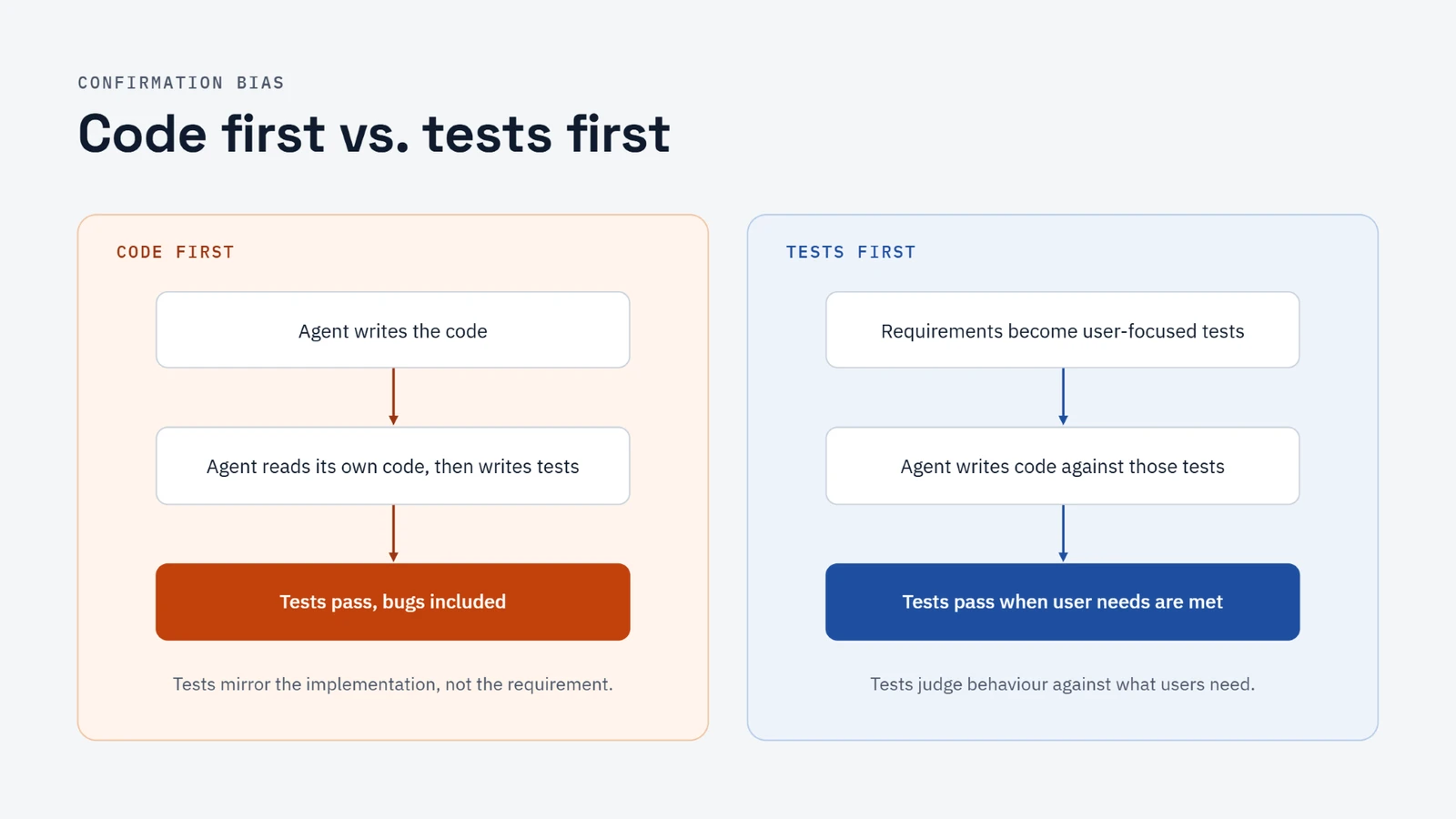
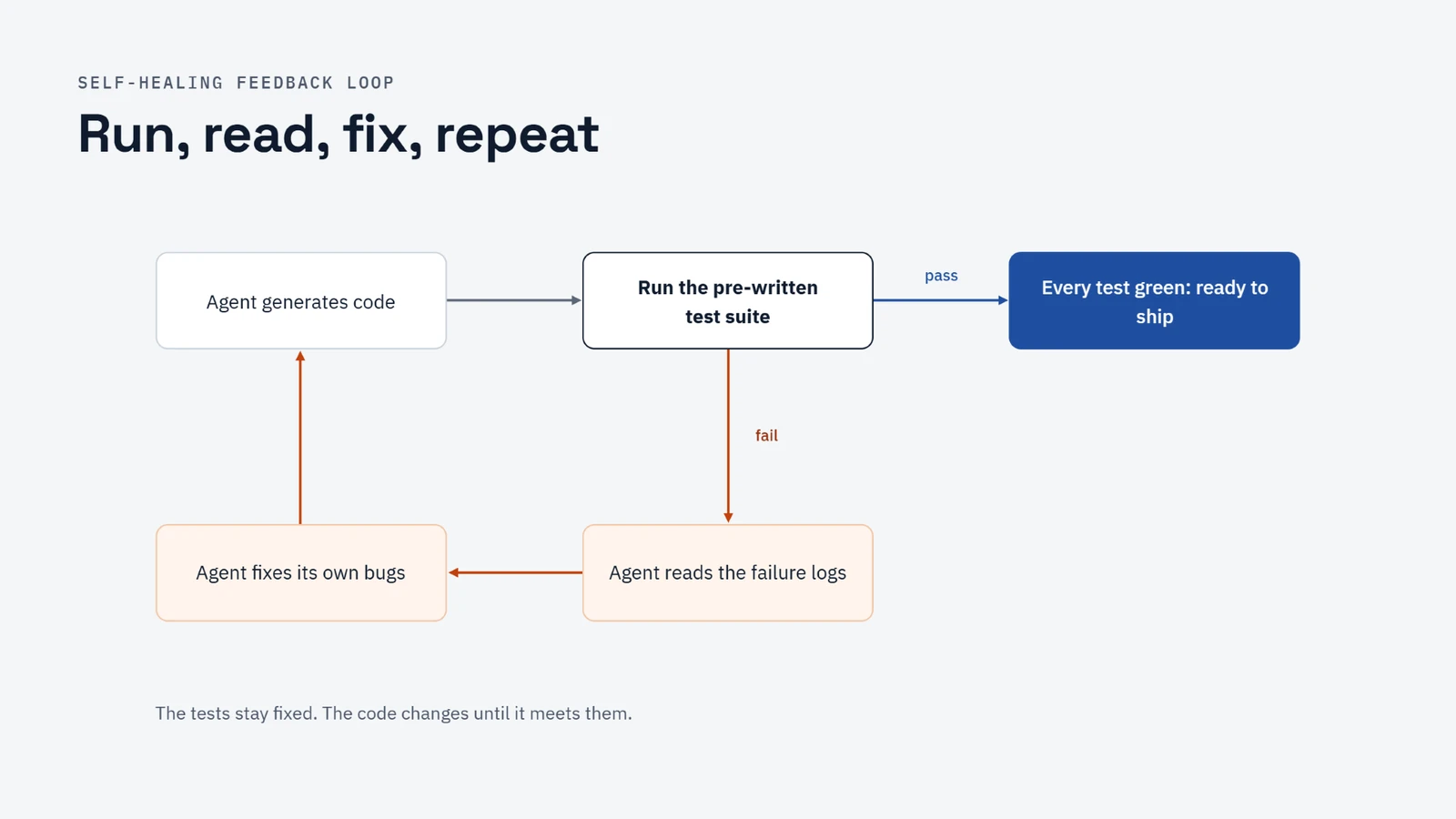
Flipping the script and creating test cases first changes how the AI operates. Pre-written test cases act like a strict, detailed checklist for the agent. The AI knows exactly what success looks like before it writes its first line of code. Because the tests are generated independently from the implementation, they evaluate actual business goals rather than mirroring the AI’s internal shortcuts. A predefined test suite also enables a self-healing feedback loop. The AI agent can run its newly generated code against the tests, read the failure logs, and fix its own bugs until every test turns green. The human role shifts too. Instead of reading every line the agent produces, reviewers spend their time on what matters most: deciding whether the tests describe the right behaviour.
For pre-written test cases to deliver real value, however, they must be designed entirely from the end user’s perspective rather than a purely technical one. End users do not care which underlying framework, database schema, or architectural pattern an AI agent chooses under the hood; they only care about what happens on their screen. Test cases should focus on simple inputs, expected outputs, and everyday user actions. A good check is to hand your test list to someone outside engineering, such as a product owner or a support lead. If they can read each case and say whether it describes the right behaviour, the tests sit at the right level. If they need a developer to translate, the tests are too close to the code.
Real users also do unpredictable things, so test suites need to account for messy, real-world behaviour. Your pre-written tests should explicitly check what happens when a user submits an incomplete form, rapidly double-clicks a submit button, or loses internet connectivity mid-action. Framing these scenarios in simple “Given-When-Then” logic keeps the requirements grounded in real user behaviour. For example: given a user whose subscription has expired, when they click a premium link, then they see a clear renewal page instead of an ugly server crash.
It also helps to keep the tests free of implementation detail. A test that says “the form returns a 200 status code and writes a row to the orders table” ties the agent to one design. A test that says “after submitting the form, the user sees a confirmation and the order appears in their order history” describes the outcome and leaves the agent free to choose how to build it. If the agent picks a poor design, the tests still catch the problem, because they measure results rather than methods.
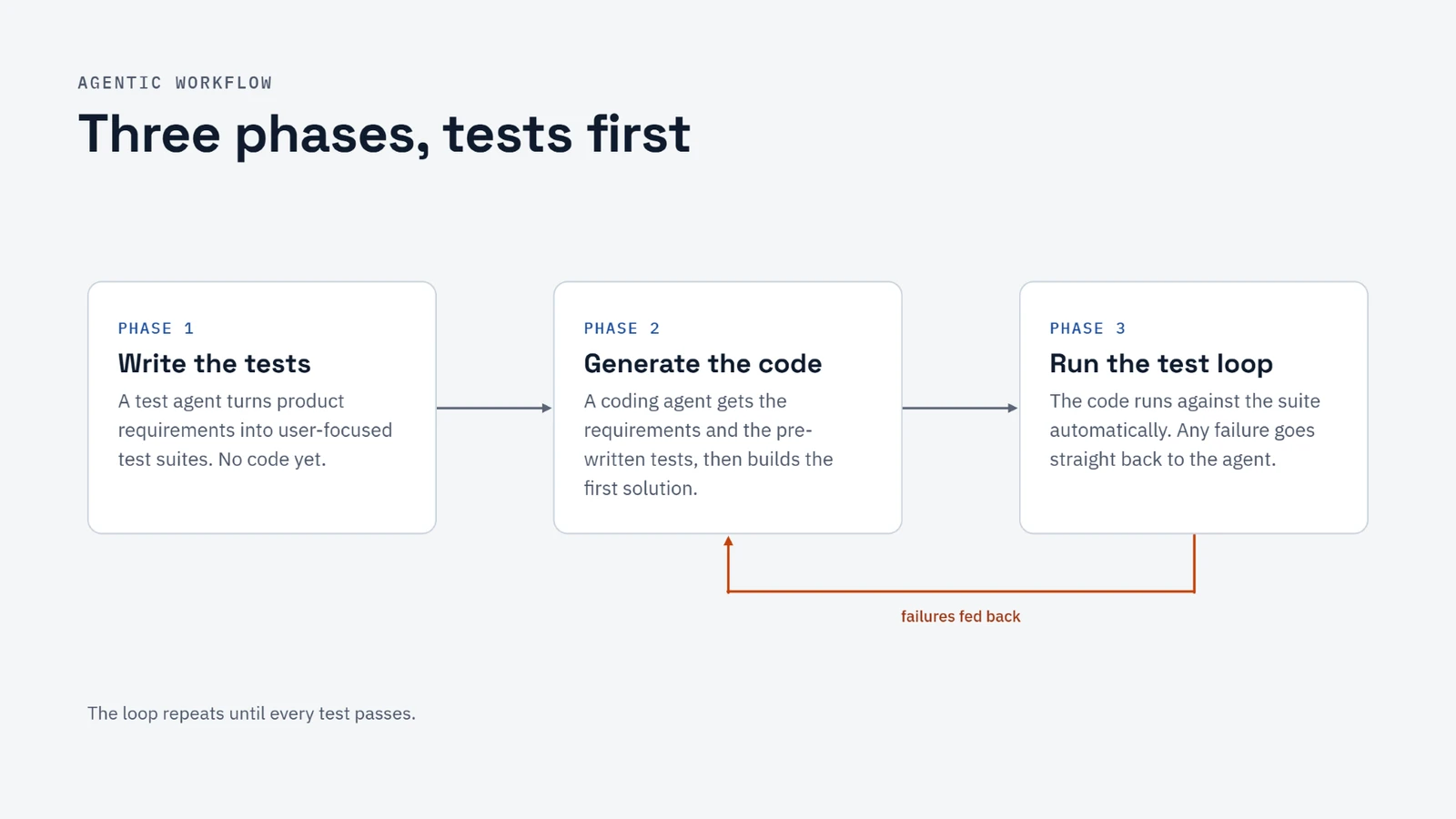
To make this approach work in practice, you can structure your agentic workflow into three continuous phases. First, an agent translates product requirements into user-focused test suites before any code is written. A human reviewer should read these suites before moving on, since every later step depends on them. Next, a coding agent receives both the functional requirements and the pre-written test cases to generate the initial solution. Finally, an automated test loop runs the code against the test suite and feeds any failures back to the AI for debugging. The loop stops when all tests pass or when it hits a set number of attempts, at which point a person steps in.
This approach has limits. Tests written by an AI can still contain mistakes, and a passing suite only proves that the software does what the tests describe. That is why the review step in the first phase matters, and why the person who owns the requirements should sign off on the test cases, not only the code. AI agents can write code faster than any human developer, but raw speed means nothing if the software breaks for real users. Start your next feature by writing the tests first, then let the agent build to them.